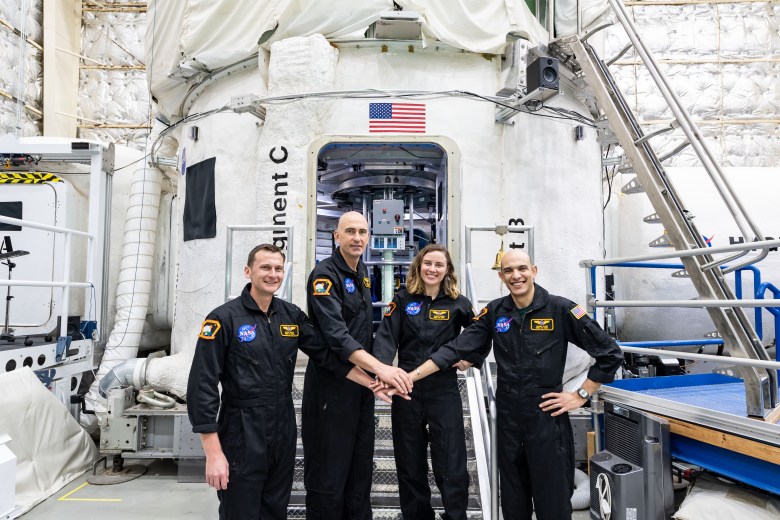
In 2020, I had the incredible honor of serving as Mission Specialist 1 for NASA’s Human Exploration Research Analog (HERA) program at Johnson Space Center in Houston, TX. HERA is a high-fidelity habitat designed to simulate the isolation, confinement, and teamwork challenges of deep space travel — all from an airplane hanger at JSC! For 45 days, my four-person crew “journeyed” to the Martian moon Phobos and back, following a flight-like timeline complete with science operations, habitat maintenance, simulated EVAs (extravehicular activities), and time-delayed communications.
To help NASA scientists understand and study the astronaut experience, we wore biometric monitors, completed daily cognitive tests, and filled out a host of surveys. Researchers will use this data to track how we adapted to the stress of lack of privacy, little autonomy, sleep disruption, and delayed communication with “Mission Control.”
I absolutely loved being part of HERA! I have my wonderful crew mates to thank for that. While it was challenging at times, I never lost sight of what a privilege it is to contribute to the legacy of crewed spaceflight in a small way. The data we collected will improve conditions for astronauts on the ISS and guide preparations for future missions to the Moon and Mars. Being an analog astronaut (or “HERAnaut”) was an unforgettable experience!
 Carolynn Harris, PhD