I am excited to share that a chapter of my dissertation research on ltitled, ““Lipid Hydrogen Stable Isotope Probing Reveals Archaeal Lipid Turnover in Hot Spring Sediments,” is in press at JGR Biogeosciences and a preprint is available on bioRxiv. (link)
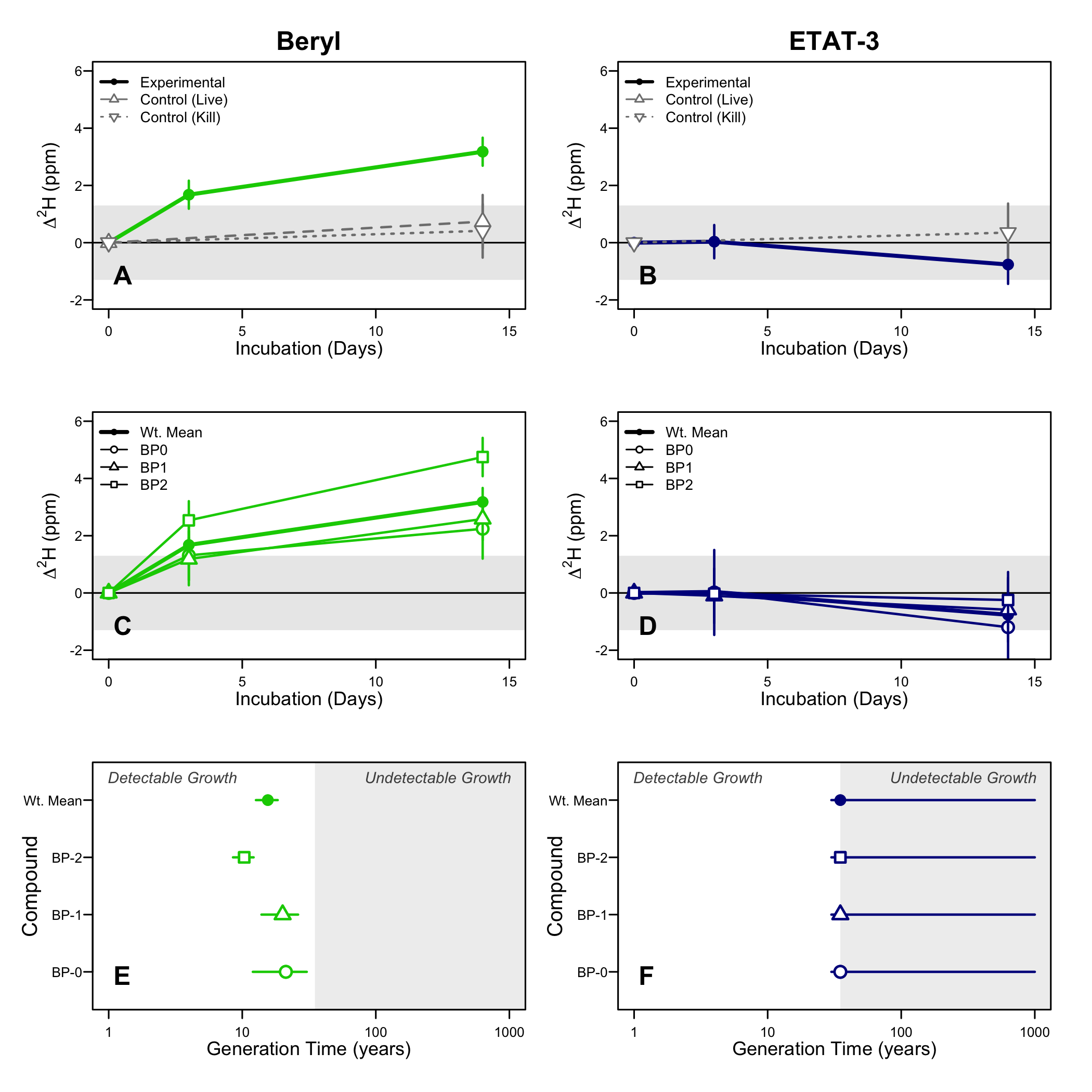
Using lipid hydrogen stable isotope probing (LH-SIP), we measured archaeal lipid biosynthesis and turnover in high-temperature hot spring sediments from Yellowstone National Park and the El Tatio Geyserfield in Chile. We observed minor but measurable deuterium incorporation into archaeal IPL-iGDGT-derived biphytanes at Yellowstone, corresponding to apparent turnover on decadal timescales, while no resolvable uptake was detected at El Tatio under the conditions of the experiment.
Rather than interpreting these apparent turnover times as direct measures of archaeal cell division, our results suggest that they likely integrate multiple processes, including persistence of older intact polar lipids and recycling or re-functionalization of relict lipid components. These processes can decouple lipid turnover from cellular growth and help explain how detectable archaeal lipid inventories can persist even when rates of new lipid production are very low. The work provides new constraints on archaeal lipid dynamics in hydrothermal sediments and informs interpretation of lipid biosignatures in ancient terrestrial and Martian hydrothermal deposits.
Key findings
- Demonstrated the application of LH-SIP to terrestrial hot spring sediments
- Constrained archaeal IPL-iGDGT-derived biphytane turnover to decadal timescales
- Showed that apparent lipid turnover can be decoupled from cellular growth by lipid persistence and potential recycling
- Provided a framework for interpreting archaeal lipid biosignatures in hydrothermal systems relevant to early Earth and Mars exploration